The Rhipsalideae are a small tribe of cacti, comprising four genera (and around 60 species). They grow on trees (epiphytes) or on rocks (lithophytes), where they either hang down or form creeping or upright shrubs. Their flowers open in the day and remain open at night; they may be either radially symmetrical (regular) or bilaterally symmetrical (zygomorphic). The fruits are berry-like, fleshy with smallish seeds.[1]
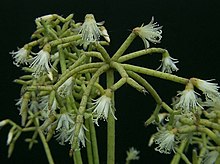

They are found mainly in the east of South America, with a centre of diversity in Bolivia,[2] but some species occur in Central America and North America; one species, Rhipsalis baccifera, also occurs in the Old World.[1]
Taxonomy
Cacti belonging to the Rhipsalidae are quite distinct in appearance and habit from other cacti, growing on trees or rocks as epiphytes or lithophytes, and are thus easily distinguished. However, for many years there has been confusion as to how to divide the tribe into genera.[3] For example, in 1858 Charles Lemaire recognized the distinctiveness of the species then called Epiphyllum russellianum by creating the genus Schlumbergera. However he kept the only other species of Schlumbergera known at the time in a different genus.[4] As another example, in 1923, Nathaniel Britton and Joseph Rose created the genus Hatiora. Of the species known at the time, they placed two in Hatiora (H. salicornioides and H. cylindrica); they left H. gaertneri in Schlumbergera where they had placed it in 1913, and they placed H. rosea in a new genus, Rhipsalidopsis.[5] According to Anderson,[3] the confusion among the Rhipsalideae was not clarified until work by Wilhelm Barthlott and Nigel Taylor in 1995.[6]
Recent molecular phylogenetic studies have led to a slight modification of the approach taken by Barthlott and Taylor, since with their circumscriptions, Hatiora and Schlumbergera were not monophyletic. One hypothesis for the relationships between the genera is shown below. The yellow shading shows species formerly placed in Hatiora, but which were moved by Calvente et al. to a more broadly defined Schlumbergera.[7]
An alternative approach uses the genus Rhipsalidopsis for the two species Schlumbergera rosea and Schlumbergera gaertneri, which are treated as Rhipsalidopsis gaertneri and Rhipsalidopsis rosea.[8][9]
Genera
The genera included in the tribe as of June 2019 are as follows,[7] with species counts based on Plants of the World Online:
- Hatiora Britton & Rose – 3 species;[10] synonyms include Epiphyllopsis, Hariota DC non Andan., Rhipsalidopsis and Pseudozygocactus; it has been included in Rhipsalis[5]
- Lepismium Pfeiff. – 6 species;[11] synonyms include Acanthorhipsalis, Lymanbensonia, Pfeiffera; it has been included in Rhipsalis[12]
- Rhipsalis Gaertn. – 43 species;[13] synonyms include Erythrorhipsalis;[14] most species in the tribe have been placed here at one time or another
- Schlumbergera Lem. – 9 species;[15] synonyms include Epiphyllanthus, Epiphyllum Pfeiffer non. Haworth and Zygocactus[16]


| This article uses material from the Wikipedia article Metasyntactic variable, which is released under the Creative Commons Attribution-ShareAlike 3.0 Unported License. |