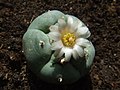
Lophophora /ləˈfɒfərə/[citation needed] is a genus of spineless, button-like cacti native to Texas from Presidio county (Big Bend National Park) south right along the Rio Grande river to Starr County, Texas. Its range continues south through Northeast and north central Mexico to Querétaro in central Mexico.[citation needed] The species are extremely slow growing, sometimes taking up to thirty years to reach flowering age (at the size of about a golf ball, excluding the root) in the wild.[citation needed] Cultivated specimens grow considerably faster, usually taking between three and ten years to reach from seedling to mature flowering adult.[citation needed] The slow rate of reproduction and over-harvesting by collectors render the species under threat in the wild.[citation needed]


Taxonomy
Lophophora means "crest-bearing", referring to the tufts of trichomes that adorn each tubercle. Lophophora has been reported to have two species, L. diffusa and L. williamsii. Another three species have been proposed[by whom?]: L. fricii, L. koehresii, and L. alberto-vojtechii.[1] Recent DNA sequencing studies (Butterworth et al. 2002) have shown that L. diffusa and L. williamsii indeed are distinct species. DNA evidence from the alleged species L. fricii and L. koehresii would allow for more accurate classification.[2]
Species

Ethnobotany
Lophophora species easily adapt to cultivation, requiring warm conditions and a free-draining substrate, and to be kept dry in winter.
| This article uses material from the Wikipedia article Metasyntactic variable, which is released under the Creative Commons Attribution-ShareAlike 3.0 Unported License. |