Hatiora salicornioides, the bottle cactus, dancing-bones, drunkard's-dream,[3] or spice cactus,[4] is a species of flowering plant in the cactus family. A member of the tribe Rhipsalideae, it often grows as an epiphyte. It is native to eastern Brazil. It is sometimes grown both indoors and outdoors as an ornamental.



Description
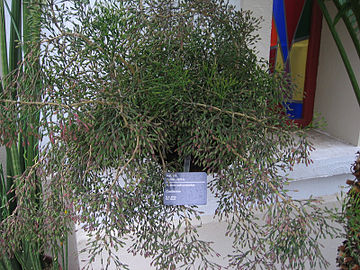
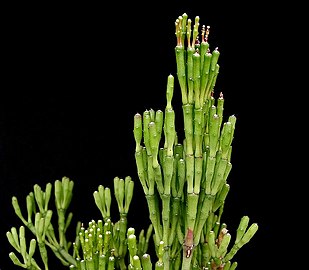
Hatiora salicornioides grows to about 1 m (3 ft) tall with an erect to pendent growth habit. Its stems are composed of segments 1.5–5 cm (0.6–2.0 in) long. Each segment is shaped like a club or bottle, with the narrower end at the base. The stems branch from the end of a segment, with up to six branches forming a whorl. The yellow to orange flowers are borne at the ends of younger stem segments, and are 1–2 cm (0.4–0.8 in) long and about the same across when open. Translucent white berries follow the flowers.[5]
Taxonomy
The species was first described by Adrian H. Haworth in 1819, as Rhipsalis salicornioides. (Haworth actually spelt the epithet "salicornoides", but subsequent authors have corrected the spelling, treating the original as an orthographic error.)[6] The epithet means "similar to Salicornia". The species was transferred to the genus Hatiora in 1915 (after previously being placed in the confused and hence abandoned genus Hariota).[2] Molecular phylogenetic studies have confirmed its placement in the genus and in the tribe Rhipsalideae, and also shown that it is closely related to H. cylindrica (which has been included in H. salicornioides as a form or variety). H. salicornioides is very variable, and may possibly include other distinct species.[7][8]
Distribution and habitat
Hatiora salicornioides is found in the east of Brazil, in the regions of Northeast Brazil (Bahia), Southeast Brazil (Espírito Santo, Minas Gerais, Rio de Janeiro and São Paulo) and South Brazil (Paraná).[1][2] It occurs in moist forest, savanna and rocky areas at elevations of 200–1,750 m (660–5,740 ft). It is usually epiphytic or lithophytic.[1]
Cultivation
Hatiora salicornioides is grown as an ornamental plant. It requires some humidity, and is not frost-tolerant. Light shade and a minimum average temperature of 12 °C (54 °F) are recommended. Given these conditions, it has been successfully cultivated outside in Phoenix, Arizona. In climates with lower winter temperatures, it is cultivated in greenhouses or as a house plant. It is propagated by stem cuttings.[4][9]
In the UK Hatiora salicornioides has gained the Royal Horticultural Society's Award of Garden Merit.
| This article uses material from the Wikipedia article Metasyntactic variable, which is released under the Creative Commons Attribution-ShareAlike 3.0 Unported License. |