Echinopsis eyriesii is a species of cacti of the genus Echinopsis.

Habitat
Its original habitat is Southern Brazil, Uruguay, and province of Entre Ríos Province, Argentina. It grows in grassy plains or in low hills in lowland up to 1.000 metres above sea level. The climate is tropical, continental. Winters are completely dry, while in summer the landscape is flooded by torrential rain and soaked with water. Rainfall up to 1500 mm by year. Average annual temperature 25-30 °C. Rarely the temperature drop below zero degrees even if the landscape is open to the cold south pamperos winds [1]
Taxonomy
The species is dedicated to Alexandre Eyries, le Havre, France.
Description
Source :[1]

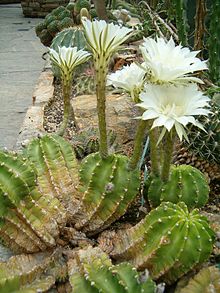
E. eyriesii is a very popular large caespitose cactus, widely grown for the huge nocturnal flowers. It is the best known and most commonly grown globular cactus.
In favorable conditions and after a long time, it may exceptionally forms large mounds up to 1,5 m tall and 2–3 m wide.
It is globular, later elongated and almost cylindrical, 15–30 cm high, 12 to 15 cm thick, dark green and heavily ribbed (9 to 18). On the ribs, there are circular areoles with very short spines (10 to 18).
The flower is very spectacular. The floral stem grows slowly (one month) up to 20 cm long. Then, on a spring or summer evening, the flower (white or light pink) opens with 10–12 cm in diameter. There is a light and delicious smell. It fades the next day, but in cold, rainy weather it may last two, rarely three days.
There is a variety without spines : Echinopsis eyriesii var. inermis, sometimes named Echinopsis inermis [2]
Cultivation
Source :[1]
Echinopsis eyriesii is an easy to grow plant. It needs a fertile and well drained soil with sunny exposure.
Water the plants well in summer, but let them dry before watering again. Use then special fertilizer for cacti. In winter keep dry. The temperature may be as low as -7 °C. For flowering in summer, the rest (dry and cold) in winter is necessary.
| This article uses material from the Wikipedia article Metasyntactic variable, which is released under the Creative Commons Attribution-ShareAlike 3.0 Unported License. |