Echinopsis atacamensis (cardón) is a species of cactus from Chile, Argentina and Bolivia. The wood of this species can be used in building and in making furniture.[1]

Description
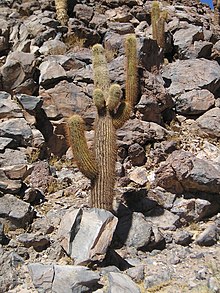
Echinopsis atacamensis has a tall columnar habit, sometimes forming branches and becoming treelike. It grows to about 10 m (33 ft) high, with stems to 70 cm (27.6 in) across. The stems have 20-30 ribs and areoles with 50-100 maroon coloured spines, the longest up to 30 cm (12 in) long. The rose-white flowers are 10–14 cm (3.9–5.5 in) long, borne on the sides of the stems. The dark green fruits are densely covered with hairs, up to 5 cm (2.0 in) long; they are edible.[1]


Systematics
Echinopsis atacamensis was first described by Rodolfo Philippi as Cereus atacamensis in 1860. It was placed in a number of genera, including Trichocereus and Helianthocereus, before being moved to Echinopsis by Helmo Friedrich and Gordon Rowley in 1974.[1]
There are two recognized subspecies. Subspecies pasacana is often branched, and occurs in Argentina and Bolivia. Subspecies atacamensis is usually unbranched, less tall (up to 6 m (20 ft) rather than 10 m (33 ft)), and is found in Chile.
| This article uses material from the Wikipedia article Metasyntactic variable, which is released under the Creative Commons Attribution-ShareAlike 3.0 Unported License. |