Acanthocereus is a genus of cacti. Its species take the form of shrubs with arching or climbing stems up to several meters in height. The generic name is derived from the Greek word άκανθα (acantha), meaning spine,[3] and the Latin word cereus, meaning candle.[4] The genus is native to the mostly tropical Americas from Texas and the southern tip of Florida to the northern part of South America (Colombia and Venezuela), including islands of the Caribbean.[5]

Description
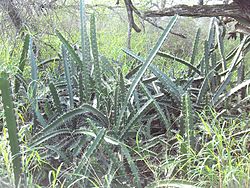
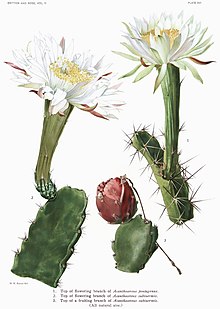
The plants form bushes which later usually overhanging or spreading and are rarely tree-shaped. Stems have 3 to 5 ribs, typically thin, with stout spines. The large, white, funnel-shaped flowers are night-opening, 12–25 cm (4.7–9.8 in) long and 6–12 cm (2.4–4.7 in) in diameter and open at night. The little scaly pericarpel and the long, stiff, upright flower tube are covered with a few thorns that soon decay and little wool. The fruits are spherical to ovoid or pear-shaped red or green, bare or thorny, tear-open or non-tear-open and contain broadly oval, shiny black seeds of up to 4.8 millimeter.[citation needed]
Taxonomy
The name was first used by George Engelmann in 1863, although he did not describe its characters, leaving it to Alwin Berger in 1905 to define it as a subsection of Cereus. In 1909, Nathaniel Britton and Joseph Nelson Rose elevated Acanthocereus to a genus.[6]
Species
As of March 2021, Plants of the World Online accepted the following species:[5]
- Acanthocereus canoensis (P.R.House, Gómez-Hin. & H.M.Hern.) S.Arias & N.Korotkova
- Acanthocereus castellae (Sánchez-Mej.) Lodé
- Acanthocereus chiapensis Bravo
- Acanthocereus cuixmalensis (Sánchez-Mej.) Lodé
- Acanthocereus fosterianus (Cutak) Lodé
- Acanthocereus haackeanus Backeb. ex Lodé
- Acanthocereus hesperius D.R.Hunt
- Acanthocereus hirschtianus (K.Schum.) Lodé
- Acanthocereus macdougallii (Cutak) Lodé
- Acanthocereus maculatus Weingart ex Bravo
- Acanthocereus oaxacensis (Britton & Rose) Lodé
- Acanthocereus rosei (J.G.Ortega) Lodé
- Acanthocereus tepalcatepecanus (Sánchez-Mej.) Lodé
- Acanthocereus tetragonus (L.) Hummelinck
Species formerly placed in the genus that have been moved to other genera include:
- Acanthocereus brasiliensis Britton & Rose → Strophocactus brasiliensis[2]
- Acanthocereus sicariguensis Croizat & Tamayo → Strophocactus sicariguensis[2]
Distribution
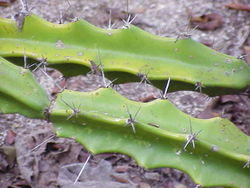
Acanthocereus tetragonus, commonly known as Barbed-wire Cactus, Chaco, Nun-tsusuy, or Órgano, is the most widespread of the genus and the largest, reaching 2–7 m (6.6–23.0 ft) tall.
| This article uses material from the Wikipedia article Metasyntactic variable, which is released under the Creative Commons Attribution-ShareAlike 3.0 Unported License. |